
Executive Summary
FactReview was officially recognized as a Trusted Flagger by Greece’s Digital Services Coordinator (Hellenic Telecommunications and Post Commission – EETT) on November 4, 2024. Between November 2024 and January 2025, no reports were submitted to online platforms. Nevertheless, FactReview conducted an analysis of the broader activity of major online media during this period and submitted a special report on the effectiveness of illegal content monitoring systems related to sponsored advertisements on Facebook. This report was subsequently presented to the European Parliament’s Committee on the Internal Market and Consumer Protection (IMCO) in March 2025.
During the first four months of 2025, FactReview, as an officially designated Trusted Flagger under the Digital Services Act (DSA) in Greece, submitted a total of 10 detailed reports concerning advertisements and sponsored content targeting Greek users. All cases involved clear indicators of fraud, deception, or unlawful commercial practices, including phishing scams impersonating well-known retail brands (Decathlon, Plaisio), the unauthorized promotion of pharmaceutical products (Insuvit, Hondro Sol), misuse of official insignia and names of public health authorities, and the systematic use of fabricated testimonials and aggressive sales tactics.
All flagged cases were thoroughly documented with supporting evidence and legal analysis referencing relevant provisions of Greek criminal, consumer protection, and pharmaceutical law, as well as applicable EU directives. The submitted reports led to the prompt review and removal of the flagged content, with 100% acceptance and action taken by the platform, typically within 2 to 4 days of submission.
Key highlights of this reporting period include:
- Disruption of an extensive phishing scam exploiting Decathlon and Plaisio brand names to deceive users into providing sensitive financial information in exchange for fictitious “discounted” products.
- Identification and takedown of fraudulent advertisements for unapproved medical products targeting vulnerable groups, accompanied by fabricated expert endorsements and unauthorized use of state symbols.
- Systematic documentation of patterns in scam design, including use of fake user reviews, false scarcity tactics, and misleading claims about product efficacy.
- Ongoing collaboration with national regulatory authorities, including referral of certain cases for further action and public health warnings.
1. Introduction & Methodology
1.1 Purpose of the report
The purpose of this report is to provide the Digital Services Coordinator and relevant stakeholders with a comprehensive account of FactReview’s activities as an officially designated Trusted Flagger under the Digital Services Act (DSA) in Greece for the reporting period Q2 2025. The report documents the nature, volume, and outcomes of all content flagged as potentially illegal on Very Large Online Platforms (VLOPs), with a focus on transparency, accountability, and the protection of consumers and the public from fraudulent and deceptive practices online. This report aims to fulfil our obligations under Article 22 of the DSA by presenting an evidence-based overview of our work, supporting effective oversight, and enabling continuous improvement in cooperation with online platforms.
1.2 Scope of activities
During the reporting period, FactReview’s activities as a Trusted Flagger focused primarily on the identification, documentation, and reporting of illegal content that exhibited clear indicators of fraud, deception, and other illegal practices, particularly in relation to phishing scams, the promotion of unauthorized pharmaceuticals, the misuse of public authority insignia, fake user testimonials, and aggressive sales tactics. All reported cases originated from Greece and targeted the Greek-speaking public. Our scope also included legal analysis of the reported content, referencing specific provisions of Greek law and relevant EU directives to substantiate the illegality of the flagged material.
1.3 Short description of methodology
FactReview employs a multi-stage methodology to ensure the accuracy, relevance, and legal substantiation of each Trusted Flagger submission:
- Content Identification: Cases are flagged for review through continuous monitoring of content from all registered VLOPs/VLOSEs, like for example Facebook’s advertising library, user reports, and FactReview’s own investigative workflows.
- Preliminary Assessment: Each case undergoes an initial assessment to determine whether it meets the DSA criteria for illegal content, including fraud, deception, or other violations.
- Evidence Collection: The team collects and archives all relevant evidence, such as URLs, screenshots, and, where necessary, video captures. Secure sandbox environments are used to safely investigate suspicious links and document user flow and risks.
- Legal Analysis: The legal and regulatory context of each case is analyzed, referencing Greek criminal, commercial, and consumer protection law, as well as applicable EU directives, to ensure each report is substantiated with clear legal grounding.
- Report Submission: For each case, a comprehensive report is drafted and submitted via the Trusted Flagger channel, attaching supporting documentation and specifying the relevant legal provisions.
- Outcome Tracking: The status and outcomes of all submitted reports are systematically tracked, including platform response times and decisions, to inform performance analysis and transparency reporting.
2. VLOPs & VLOSEs Analysis
2.1 Platforms Contacted & Collaboration
2.1.1 Platforms status
| Platform | Status | Initial contact by | Initial contact date |
|---|---|---|---|
| DailyMotion | Collaboration established | The platform | 06/12/2024 |
| Collaboration established | The platform | 06/12/2024 | |
| Ebay | Collaboration established | The platform | 17/12/2024 |
| Snapchat | Collaboration established | The platform | 20/12/2024 |
| AliExpress | Collaboration established | The platform | 30/12/2024 |
| Meta | Collaboration established | The platform | 03/01/2025 |
| Aylo | Collaboration established | The platform | 14/02/2025 |
| Collaboration established | The platform | 01/05/2025 | |
| Whaleco Technology (Temu) | Collaboration established | FactReview | 25/05/2025 |
| Zalando | Collaboration established | FactReview | 25/05/2025 |
| Technius | Collaboration established | FactReview | 25/05/2025 |
| Collaboration established | FactReview | 25/05/2025 | |
| Apple | Initial contact made | Pending response | FactReview | 25/05/2025 |
| Booking | Initial contact made | Pending response | FactReview | 25/05/2025 |
| Initial contact made | Pending response | FactReview | 25/05/2025 | |
| TikTok | Initial contact made | Pending response | FactReview | 25/05/2025 |
| WebGroup | Initial contact made | Pending response | FactReview | 25/05/2025 |
| Wikimedia Foundation | Initial contact made | Pending response | FactReview | 25/05/2025 |
| Amazon | Initial contact made | FactReview | 25/05/2025 |
| Infinite Styles Services (Shein) | Initial contact made | FactReview | 25/05/2025 |
| NKL Associates | Initial contact made | FactReview | 25/05/2025 |
| Microsoft | Initial contact made | Issues with communication | FactReview | 25/05/2025 |
2.1.2 Nature of collaboration, communication channels, technical problems
| Platform | Nature of collaboration | Communication channels | Technical problems |
|---|---|---|---|
| DailyMotion | Regular collaboration through prioritization of reports submitted by FactReview as Trusted Flagger. No other type of collaboration. | Submission of reports through a special portal for Trusted Flaggers with specialized fields for submitting detailed information regarding the type of illegal content we report and a system for tracking reports. | No problems during the reported period. |
| Regular collaboration through prioritization of reports submitted by FactReview as Trusted Flagger. No other type of collaboration. | Submission of reports through a special portal for Trusted Flaggers with specialized fields for submitting detailed information regarding the type of illegal content we report and a system for tracking reports. | No problems during the reported period. | |
| Ebay | Regular collaboration through prioritization of reports submitted by FactReview as Trusted Flagger. No other type of collaboration. | Submission of reports through a special portal for Trusted Flaggers with specialized fields for submitting detailed information regarding the type of illegal content we report and a system for tracking reports. | A small technical issue with the login and onboarding during the initial setting of the account. The ebay point of contact solved it very soon after we communicated the issue. |
| Snapchat | Regular collaboration through prioritization of reports submitted by FactReview as Trusted Flagger. No other type of collaboration. | Submission of reports through a special portal for Trusted Flaggers with specialized fields for submitting detailed information regarding the type of illegal content we report and a system for tracking reports. | No problems during the reported period. |
| AliExpress | Regular collaboration through prioritization of reports submitted by FactReview as Trusted Flagger. No other type of collaboration. | Submission of reports through a special portal for Trusted Flaggers with specialized fields for submitting detailed information regarding the type of illegal content we report and a system for tracking reports. | No problems during the reported period. |
| Meta | Regular collaboration through prioritization of reports submitted by FactReview as Trusted Flagger. No other type of collaboration. | Submission of reports through a special portal for Trusted Flaggers with specialized fields for submitting detailed information regarding the type of illegal content we report and a system for tracking reports. | No problems during the reported period. |
| Aylo | Regular collaboration through prioritization of reports submitted by FactReview as Trusted Flagger. No other type of collaboration. | Submission of reports through a special portal for Trusted Flaggers with specialized fields for submitting detailed information regarding the type of illegal content we report and a system for tracking reports. | No problems during the reported period. |
| Regular collaboration through prioritization of reports submitted by FactReview as Trusted Flagger. No other type of collaboration. | Reporting through a simple submission form, similar to the one used for submission of reports from the public, with no additional fields for more detailed reporting, nor a tracking system of reports. | No problems during the reported period. |
2.2 Key Indicators & Statistics
2.2.1 Trusted Flagger Activity Data Table (Q1 2025)
| Case # | Full report URL | Platform | Submission Date | Decision Date | Response Time (days) | Outcome | Content Type |
|---|---|---|---|---|---|---|---|
| 1 | Full Report | 2025-04-29 | 2025-04-29 | 0 | Report accepted and reported content removed | Phishing | |
| Fake Reviews | |||||||
| 2 | Full Report | 2025-04-29 | 2025-05-01 | 2 | Report accepted and reported content removed | Fraudulent Medical Claims | |
| Official Symbol Misuse | |||||||
| Fake Reviews | |||||||
| 3 | Full Report | 2025-05-07 | 2025-05-09 | 2 | Report accepted and reported content removed | Phishing | |
| Fake Reviews | |||||||
| 4 | Full Report | 2025-05-07 | 2025-05-09 | 2 | Report accepted and reported content removed | Phishing | |
| Fake Reviews | |||||||
| 5 | Full Report | 2025-05-10 | 2025-05-14 | 4 | Report accepted and reported content removed | Fraudulent Medical Claims | |
| AggressiveSales/Subscription Trap | |||||||
| Official Symbol Misuse | |||||||
| Fake Reviews | |||||||
| 6 | Full Report | 2025-05-28 | 2025-05-30 | 2 | Report accepted and reported content removed | Fraudulent Medical Claims | |
| AggressiveSales | |||||||
| Official Symbol Misuse | |||||||
| Fake Reviews | |||||||
| 7 | Full Report | 2025-05-28 | 2025-06-04 | 7 | Report accepted and reported content removed | Fraudulent Medical Claims | |
| AggressiveSales | |||||||
| Official Symbol Misuse | |||||||
| Fake Reviews | |||||||
| 8 | Full Report | 2025-05-28 | 2025-05-30 | 2 | Report accepted and reported content removed | Fraudulent Medical Claims | |
| AggressiveSales | |||||||
| Official Symbol Misuse | |||||||
| Fake Reviews | |||||||
| 9 | Full Report | 2025-05-28 | 2025-05-30 | 2 | Report accepted and reported content removed | Fraudulent Medical Claims | |
| AggressiveSales | |||||||
| Official Symbol Misuse | |||||||
| Fake Reviews | |||||||
| 10 | Full Report | 2025-05-28 | 2025-05-30 | 2 | Report accepted and reported content removed | Fraudulent Medical Claims | |
| AggressiveSales | |||||||
| Fake Reviews |
2.3 Notable Cases & Highlights
2.3.1 Brief summaries of selected key cases
Case 1: Decathlon Phishing Scam
Summary:
Sponsored advertisements on Facebook falsely portrayed a supposed former Decathlon employee offering a “secret discount” on a North Face sports bag priced at €2. Users were redirected to a fraudulent website unrelated to Decathlon, where they were prompted to input sensitive banking details. The scam included fake user reviews and fabricated comments to enhance its credibility. At the end of the purchasing process, users were required to enter their banking details to buy the bag for €2; however, by accepting the terms of service before completing the transaction, they unknowingly subscribed to an unrelated service costing over €50. Thus, in addition to the risk of exposing users’ personal data, there was also the threat of financial exploitation.
Case 2: Insuvit Diabetes Cure Scam
Summary:
Facebook ads promoted an unapproved “Insuvit” product as a cure for type 2 diabetes, falsely claiming endorsement by Greek health authorities and using the insignia of the Ministry of Health. The website collected personal information and payments for a non-existent or non-authorized pharmaceutical product, leveraging fabricated testimonials and misleading claims to target vulnerable users, particularly those with health concerns.
2.3.2 Short explanation of why they’re important
- Both cases posed an immediate threat to consumer safety and financial security, targeting vulnerable populations with convincing narratives that exploited public trust in well-known brands and health authorities.
- The Decathlon phishing scam is significant for its use of social engineering tactics and credible brand impersonation, which could deceive even vigilant users and lead to direct financial losses.
- The Insuvit case stands out for its misuse of official public health credentials and targeting of individuals with serious medical conditions, which not only risks consumer finances but also public health, given the false hope and misinformation about disease treatment.
- Timely intervention and takedown of these cases likely prevented substantial harm, demonstrating the critical value of Trusted Flagger activities in upholding the DSA’s goals of online safety and platform accountability.
2.4 Content Trends & Analysis
2.4.1 Trend analysis
During this reporting period, FactReview observed a steady volume of fraudulent and deceptive advertisements targeting Greek users. Notably, there was a shift toward sophisticated phishing campaigns that exploited established brand identities and leveraged highly realistic sponsored content formats. While classic financial scams remained prevalent, the majority of the identified and reported content was health-related fraud, specifically the unauthorized promotion of pharmaceutical products, unsubstantiated medical claims, and the misuse of official insignia and expert endorsements.
Trends include:
- More aggressive and psychologically manipulative sales tactics (e.g., fake scarcity counters, urgent call-to-actions, and subscription traps).
- Wider use of fabricated or AI-generated user testimonials to simulate consumer trust and credibility.
- Greater use of cross-brand impersonation—targeting not just one, but multiple reputable companies in coordinated campaigns.
2.4.2 Patterns or recurring issues
Analysis of the reported cases reveals several recurring patterns:
- Brand Impersonation: Consistent use of major retail and public authority brands (e.g., Decathlon, Plaisio, Ministry of Health) to lend false legitimacy to scams.
- Phishing and Financial Data Harvesting: Many scams directed users to fraudulent websites that mimic legitimate services and request sensitive financial information.
- Fabricated Testimonials and Reviews: All major cases relied on fake user endorsements, sometimes using AI-generated or stock imagery, to create a misleading impression of popularity and effectiveness.
- False Scarcity and Urgency: Scams frequently employed countdown timers, “limited stock” claims, and urgent calls to action to pressure users into immediate decisions.
- Lack of Regulatory Compliance: There was a persistent disregard for Greek and EU law, particularly regarding the advertising and sale of pharmaceuticals, as well as for consumer protection standards (e.g., omission of company details, lack of withdrawal rights).
- Recycling of Scam Templates: Structural similarities between cases suggest the use of common scam templates or networks operating across multiple campaigns and product types.
3. Independence & Transparency Measures
3.1 Safeguards ensuring impartiality
FactReview maintains strict policies and structural safeguards to ensure impartiality and editorial independence in all its Trusted Flagger activities:
- Editorial Independence and Transparent Procedures: All flagging decisions are made autonomously by FactReview’s team, free from influence by external partners, advertisers, platforms, or government authorities. All cases are subject to internal review prior to submission as Trusted Flagger reports, ensuring accuracy, consistency, and objective application of criteria.
- Conflict of Interest Policies: Staff and contributors are required to declare any potential conflicts of interest, including financial, familial, or political ties, and recuse themselves from cases where such conflicts could arise.
- External Oversight: FactReview is a signatory of the International Fact-Checking Network (IFCN) Code of Principles and a member of EFCSN and EDMO, requiring regular independent audits of editorial processes and compliance with global best practices for accuracy, fairness, and non-partisanship.
- Public Disclosure: Editorial and operational guidelines, conflict of interest policies, and annual transparency statements are published on the organization’s website. All Trusted Flagger submissions and reports are based solely on objective legal and factual assessments and are also made publically available through our website.
3.2 Funding disclosures, ethical standards
FactReview is committed to full financial transparency and adheres to robust ethical standards:
- Funding Sources: FactReview’s funding comes from a diverse mix of grants from international organizations, EU-funded projects, and reader contributions. The organization does not receive funding from government entities, political parties, or digital platforms.
- Annual Disclosure: All major sources of funding (above the 5% threshold of annual revenue) are published on FactReview’s website, detailing grantors, amounts, and purpose.
- No Paid Influence: The organization explicitly rejects paid content, sponsored posts, and advertising that could influence editorial or flagging decisions.
- Ethical Commitments: FactReview’s operations are governed by the IFCN and EFCSN Codes of Principles, which include commitments to non-partisanship, transparency of sources, clear corrections policies, and public accountability.
- Public Accountability: FactReview welcomes external feedback and subjects its processes to regular review and updates.
4. Challenges & Recommendations
4.1 Obstacles encountered
A significant obstacle faced during these four months relates to the limited accessibility and transparency of the ad library search tools on certain platforms. In particular, X (formerly Twitter) only allows users to search for the names of advertising accounts and provides access to a basic CSV listing the number of ads. Unlike Meta’s Ad Library, X does not provide a comprehensive, searchable database of individual ads, their content, or targeting information. This severely limits the ability to identify, track, and report potentially illegal or dangerous advertising on the platform, undermining efforts to ensure compliance with the DSA and to protect users from harm.
4.2 Suggestions for platforms, regulators, or process improvement
4.2.1 For Platforms (Meta)
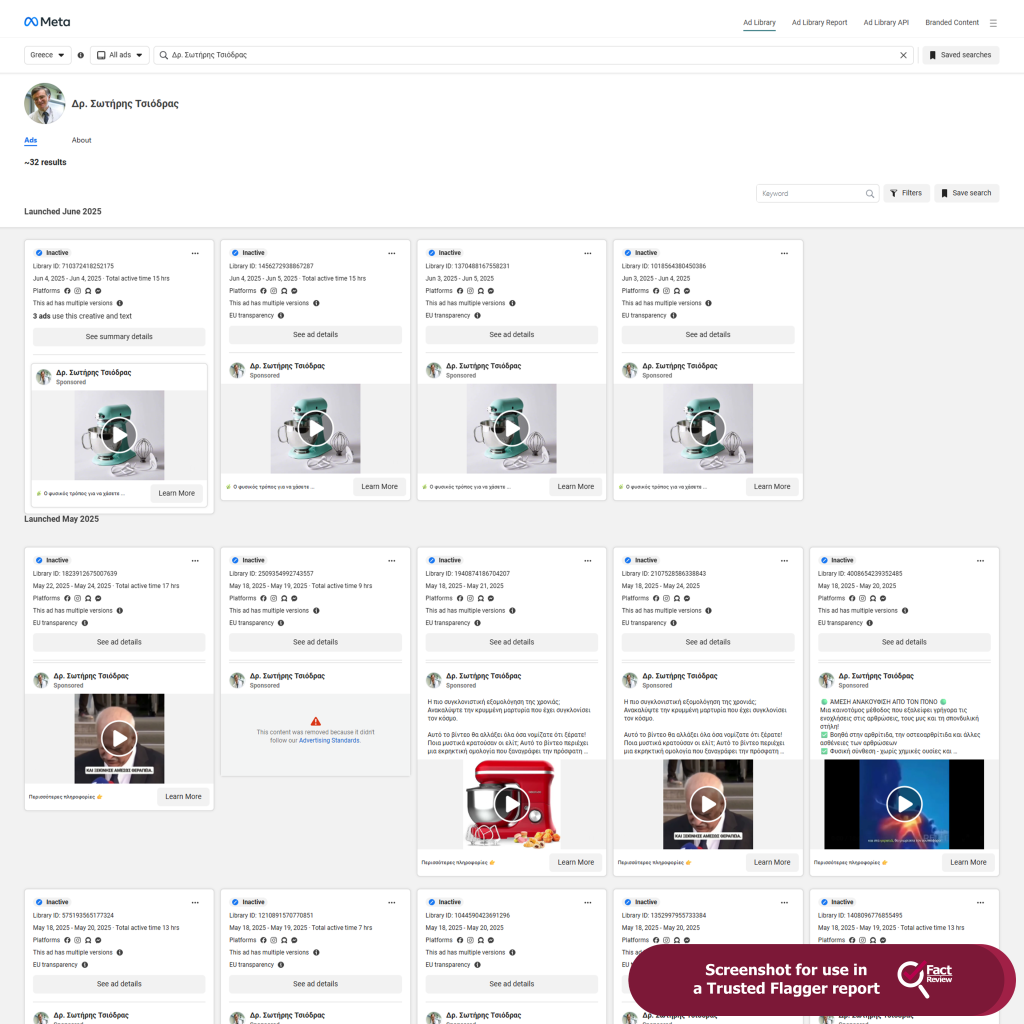
It is recommended that Meta enhance transparency in its communication regarding the consequences imposed on accounts that are repeatedly reported for posting illegal or dangerous content. During the period under review, we identified advertising accounts that, despite clearly functioning as hubs for the systematic production and promotion of fraudulent advertisements—and despite numerous posts from these accounts having been reported by FactReview and deleted by Meta—remain active.
A characteristic example involves accounts that falsely use the name of the Greek doctor, Sotiris Tsiodras, to promote unauthorized pharmaceutical products.
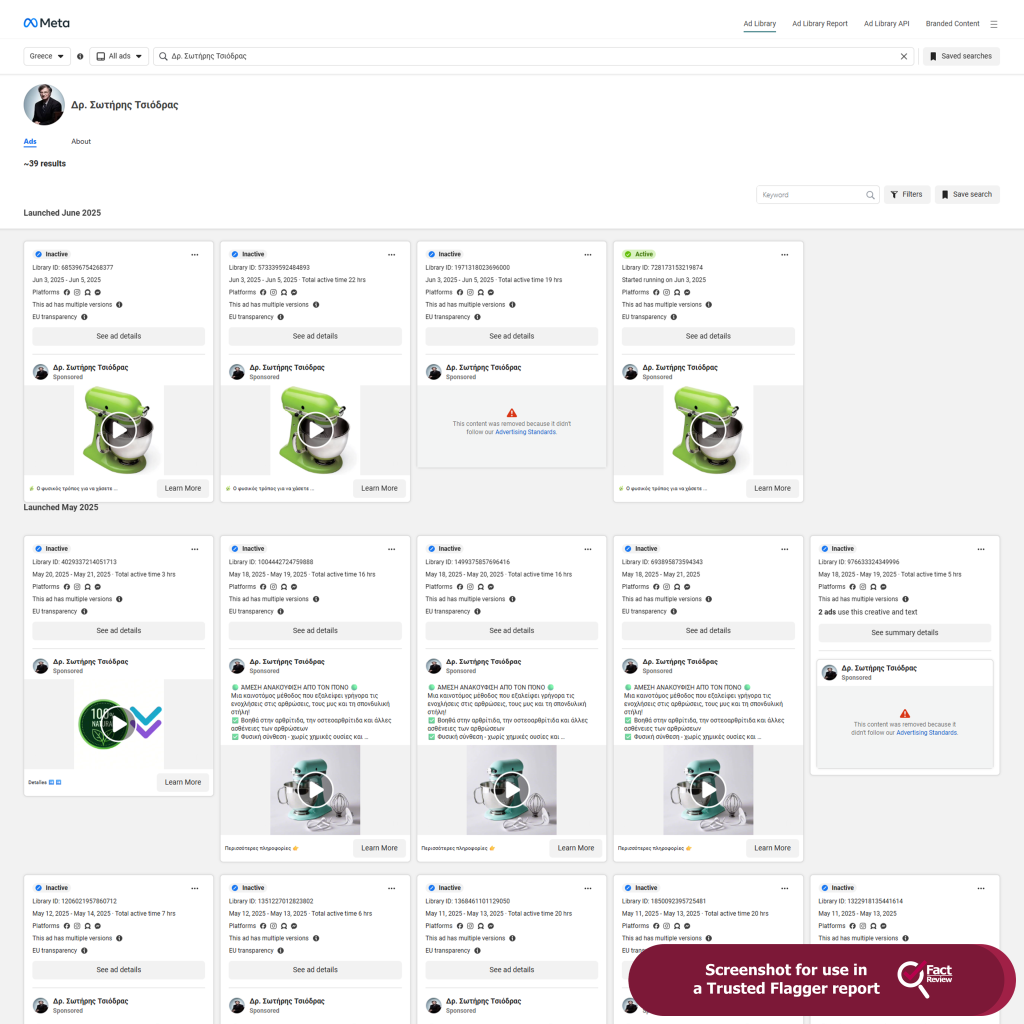
This issue was also highlighted by FactReview in the presentation of our first special report, which was submitted to the National Coordinator of Digital Services and presented to the Committee on the Internal Market and Consumer Protection of the European Parliament (IMCO) in March 2025. Specifically, it appears that Meta has limitations in staffing with regard to monitoring and regulating illegal content.
Clear communication regarding Meta’s policy—and that of other major online platforms—on the sanctions or restrictions imposed on such accounts would act as a deterrent against the recurrence of such incidents and would strengthen user trust in the reporting process.
4.2.2 For Regulators (Greek DSC and Other DSCs)
Based on FactReview’s experience, the creation of a comprehensive legal reference guidebook for Trusted Flaggers—detailing the national legislation relevant to various categories of illegal content—would be highly beneficial. While FactReview has invested significant time in compiling such a guide for Greek law, this process could be greatly streamlined if the Digital Services Coordinator (DSC) or relevant national authority provided an up-to-date, standardized resource. This would support Trusted Flaggers, especially those lacking in-house legal expertise, and improve the speed, accuracy, and consistency of reporting across all jurisdictions.
4.2.4 For Process Improvement (General)
The development and sharing of reusable tools and documentation (such as legal reference guides, reporting templates, and best practice manuals) significantly reduce the administrative burden on Trusted Flaggers and facilitate a more efficient workflow. Regulators and platforms are encouraged to support such resource development and to promote knowledge-sharing between Trusted Flaggers operating in different EU member states.
5. Next Steps & Future Plans
5.1 Plans for the next four months
For the next four months, FactReview plans to continue its proactive monitoring and Trusted Flagger submissions on VLOPs/VLOSEs and to expand systematic surveillance of advertising on other major platforms, including Instagram and TikTok, as technical capabilities allow. Priority will be given to identifying emerging scams exploiting new tactics or topical events, especially those targeting vulnerable groups with health-related misinformation or financial fraud.
As part of our activities as Trusted Flaggers, we established a collaboration with the Center for the Study of Organized Hate, an American think tank focused on researching and preventing organized violence against minority groups. Given the Center’s interest in the implications of the DSA—among other topics—for addressing violence against minority groups within the European Union, we co-organized a workshop entitled: “How South Asians in the European Union Can Use the Digital Services Act to Combat Digital Attacks” which will take place in mid-June of 2025. The purpose of the event is to inform the broader public about the Digital Services Act and the Trusted Flagging program, as well as to present the tools available to users of digital services in the European Union for reporting potentially illegal content.
Additionally, FactReview aims to increase engagement with the Greek Digital Services Coordinator (DSC) and other national authorities to support broader efforts in harmonizing reporting practices and legal references under the DSA. Where feasible, the organization will participate in working groups or forums to share best practices and challenges experienced during the flagging process.
5.2 Process improvements, new areas of focus
In the coming four months, FactReview will further refine its internal procedures by updating its legal reference guide with the latest legislative amendments relevant to DSA enforcement and Trusted Flagger reporting. A workflow automation pilot will be explored to streamline evidence collection, documentation, and status tracking for each report, aiming to reduce administrative workload and increase consistency.
New areas of focus will include deeper analysis of the tactics employed in online scams, systematic mapping of networks behind recurring frauds, and expanding cooperation with other organizations to share intelligence on cross-platform threats. Special attention will also be given to monitoring emerging content types, such as AI-generated fake testimonials and new forms of targeted manipulation, ensuring FactReview remains responsive to the evolving digital threat landscape.

Συντακτική ομάδα